


It’s no secret that Andy Burnham, Downing Street’s newest resident, is planning a transformative extension. He wants a new ‘Number 10 North’ to be the nerve centre for a rewired Britain, devolving power across the UK and delivering economic growth across the regions. Setting politics aside, a practical question runs underneath the whole vision – where will the investment come from to support this government-led region-by-region effort? For anyone who works with Guernsey’s funds sector, part of that answer is already flowing.
Burnham’s nine years as Mayor of Greater Manchester laid the foundations of what he wants to build. Number 10 North will be an extended operation of 10 Downing Street. It will be based in Manchester but work for every region, tasked with agreeing a long-term economic strategy and helping all places set new growth ambitions. His central claim is that “growth cannot be ordered from the top down [...] it can only be nurtured from the bottom up”.
Clearly much of that mission leans on public investment and public control and Burnham is candid about it. But he is equally clear that the private pound has a place. He wants to bring public and private investment together at a place-based level and encourage investors to back the aspirations set by regions. Guernsey-based investment capital has quietly been doing this across the UK for years. While Burnham’s speeches have focused more on investing national capital from tax-take, pension funds and the like, Guernsey provides an established conduit for international capital directly to where it’s needed in the UK.
£58 billion already flowing
The numbers bear it out. A September 2025 report by Frontier Economics, commissioned by Guernsey Finance, found that Guernsey-domiciled funds invest £58 billion into UK assets on an ongoing basis. Almost 90% of the assets in these funds come from non-UK investors, so this is genuinely additional international capital. Furthermore, that £58 billion is not standing still: since 2021 it has grown at around 7% a year, roughly double the pace of the UK’s overall inward direct investment. Continue on that trajectory and Guernsey’s contribution would pass £80 billion by 2029. That additional £22 billion on its own is about the sum of private finance the new National Wealth Fund is seeking to leverage across its entire mission. This is a conduit that works and is already pointed in the right direction.
Where the money lands
A Prime Minister who thinks in places will want to know where the investment actually goes, and here the Frontier report is refreshingly concrete, with some interesting case studies.
Through its Guernsey-domiciled British Sustainable Infrastructure Funds, Gresham House has backed a set of fibre network providers – Elevate, Wildanet and GoFibre – extending full-fibre broadband to communities the larger networks had passed over. Elevate alone has grown from a team of 20-30 people to more than 250 since 2021, connecting more than 20 million square feet of office space across Leeds, Liverpool, Birmingham, Manchester, Cardiff and London. The Curlew Student Fund, which was established in Guernsey in 2014, invests in student accommodation at universities including Liverpool and Durham. The Basalt Infrastructure Fund is financing FullFibre’s networks across Lancashire, Lincolnshire, Shropshire and Warwickshire, helping regions to ensure they are ready for the AI and technology-enabled future. The case studies that are included as part of this Frontier Economics report show capital being delivered across the UK, delivering investment where it’s needed.
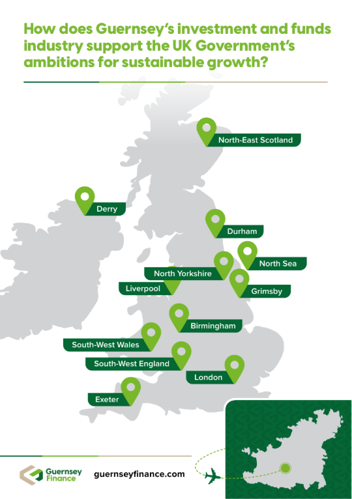
Guernsey funds invest directly across the UK’s nations and regions. Source: Guernsey Finance / Frontier Economics (2025)
Backing the next generation
Burnham wants Britain to be ‘the Innovation Nation of the next decade’, with universities at the heart of local economies and a growth model built on start-ups and scale-ups. That ambition runs on early-stage capital and was the subject of a panel I moderated, on behalf of Guernsey Finance, at last September’s UK BVCA Summit (the UK’s largest private capital gathering - the BVCA is now called UK Private Capital). On that panel I was joined by Archie Burgess, Investment Director of Cibus Capital, a Food and Agtech venture specialist that partners with universities and specialist research centres, such as the plant and crop technology focused John Innes Centre, to help spin-out companies thrive. Archie also told the audience why Cibus’s funds are domiciled in Guernsey – in short, due to time and ease of coming to market, the ability to raise capital from around the world and the lower costs of establishing and running the funds.
British universities and research centres continue to punch well above their weight globally. They are where founders from around the world come to study and meet. They set their businesses up in the towns and cities around the universities that nurtured their knowledge – just look at Oxford and Cambridge’s thriving innovation and start-up hubs. If the UK is to build on and retain this talent and the businesses they lead, it must encourage enterprise, ambition and a greater flow of international capital to help them scale. UK money can’t do it alone. Guernsey’s reputation and track record as a domicile of choice for VC funds can help drive that capital, and are doing so with a number of Channel Island funds in the pipeline with the British Business Bank (BBB), and strong working relationships between Guernsey and other Development Finance Institutions (DFIs) such as the National Wealth Fund, the British International Investment (BII) and the European Bank for Reconstruction and Development (EBRD). By proactively encouraging DFIs like the BBB to invest in Crown Dependency domiciled funds, more international capital could be attracted to backing Britain’s brightest and best new businesses.
A new front: defence and resilience
Burnham has also highlighted the importance of sovereign resilience and defence. He has promised that “every pound raised from taxpayers will work harder for them and that approach will apply fully to the Defence Investment Plan”. Here too Guernsey has moved early, fast becoming a “go-to” hub for defence investment. Over the past year the Guernsey Financial Services Commission (the jurisdiction’s regulator) has authorised three new defence funds which, according to its Director General William Mason, “plan to contribute to rebuilding NATO capabilities through their investment in defence tech”. In April the island convened a roundtable on private capital for security and resilience, attended by Lord Peach, former UK Chief of the Defence Staff, and chair of the Defence, Security and Resilience Bank Development Group. As UK public budgets strain against the scale of the task, this is another area where private capital will have to do part of the work and where a credible, well-regulated conduit and member of the British family earns its place.
Grass roots and green shoots
Guernsey’s finance industry, like Mr Burnham, has long seen the value of backing grassroots regional investment. It’s why the conduits and capital bridges have existed and worked between Guernsey and the UK for so long and it’s why Guernsey Finance has had a representative in the North of England for some time. Rowan Stone, also based in Manchester, has been actively making the case for greater capital flows and collaboration between Guernsey’s industry and the UK through numerous meetings, events, and funds and private wealth roadshows.
As Rowan and Guernsey’s countless other industry leaders and experts have been telling all who will listen, launching a new fund in Guernsey has become even simpler and more cost efficient, notably with the regulator’s Private Investment Fund pathway, where funds can receive regulatory approval in one business day. In May, at the Guernsey Funds Forum in London, industry also launched the Fund Foundry, which will help five first-time or emerging managers set their new funds up with reduced fees and mentorship. Burnham’s growth mission depends on new businesses in new places receiving investment. Guernsey is helping to ensure a pipeline of new fund managers to back businesses should not be an issue.
Why Guernsey, specifically?
The reason why managers and investors like to establish their fund structures in Guernsey is unglamourous and durable: speed to market, cost-efficiency, regulatory credibility and expertise built over more than 60 years as a specialist, globally respected finance hub, now with over £1 trillion of assets under management or administration. International investors trust the jurisdiction, which is whitelisted by both the OECD and the EU and scores highly across FATF and MONEYVAL’s standards to detect and prevent financial crime.
With Number 10 North, Burnham wants to build a conduit to carry opportunity into every UK postcode. Guernsey’s role shares a symmetry with Burnham’s aspirations. As a proud member of the British family, it is a natural and well-established conduit for international capital into the UK, with a successful track record of supporting regional investment into infrastructure, housing, innovation, business and clean energy, across all four UK nations. The most useful thing the new Prime Minister can do is not to reinvent that pipe or put bureaucratic blockers in place, but to widen it and encourage further international capital to flow through it.
As ever, if you want to discuss points raised in this article or indeed to look at how Guernsey can provide solutions for you, please do drop me a line.
About Henry Freeman: I am an independent non-executive director for a small number of investment funds, sit on the States of Guernsey Investment Board (providing oversight for the Crown Dependency's sovereign reserves and civil service and state pension assets) and am a Strategic Adviser to Guernsey Finance.
In my executive career as an investment banker I advised funds and companies on structuring, strategy, capital raising and M&A; as an investment manager I managed multi-asset and private capital funds as well as private wealth portfolios; as an entrepreneur I have established and built fintech and investment-based businesses.


